My full thesis can be found on NKUA digital repository, Pergamos.
Abstract
Greek architecture has a long history that can be dated back several millennia. A fascinating characteristic of that is how it had spread and influenced the architecture of regions near and far. In some cases, the architectural influence was spread through military campaigns such as Alexander’s. In other cases, it was later adopted for symbolic reasons. This paper analyzes the plausibility of Hellenistic influence in ancient Sri Lankan religious architecture within the framework of Transmission of Design. My study is focused on three significant characteristics between the tholos and Vatadage. The first is the structural comparison and illustrating where they share certain architectural attributes, as well as where they differ. The second is to draw a hypothetical path of influence based on historical data. The final characteristic is to compare the symbolic function of these religious structures to understand the purposes why they were built.
Introduction
After graduating from University of Texas, I visited Greece as I have a passion for learning about Greek-Roman history. The Tholos in Delphi reminded me of similar structures, Vatadage at ancient ruins in Sri Lanka (where my parents are originally from). I was intrigued to study if there is a connection. The Greek architectural influence in north India (as a result Alexander’s expeditions), and how Buddhism came to Sri Lanka during King Asoka’s reign are well known facts. My research led me to learn more about the ties between the two countries during ancient times, as well as to analyze the plausibility of transmission of design.
Greek architecture has a long history that can be dated back several millennia. A fascinating characteristic of that is how it had spread and influenced the architecture of regions near and far. In some cases, the architectural influence was spread through military campaigns such as Alexander’s. In other cases, it was later adopted for symbolic reasons, such as prominently portrayed in US governmental buildings.
This paper analyzes the plausible Hellenistic influence in ancient Sri Lankan religious architecture within the framework of transmission of design. There are several historical sources that support Greek-Sri Lankan relations even in ancient times. It is also an established fact that some of north India’s architecture was influenced by the Bactrian Greeks.
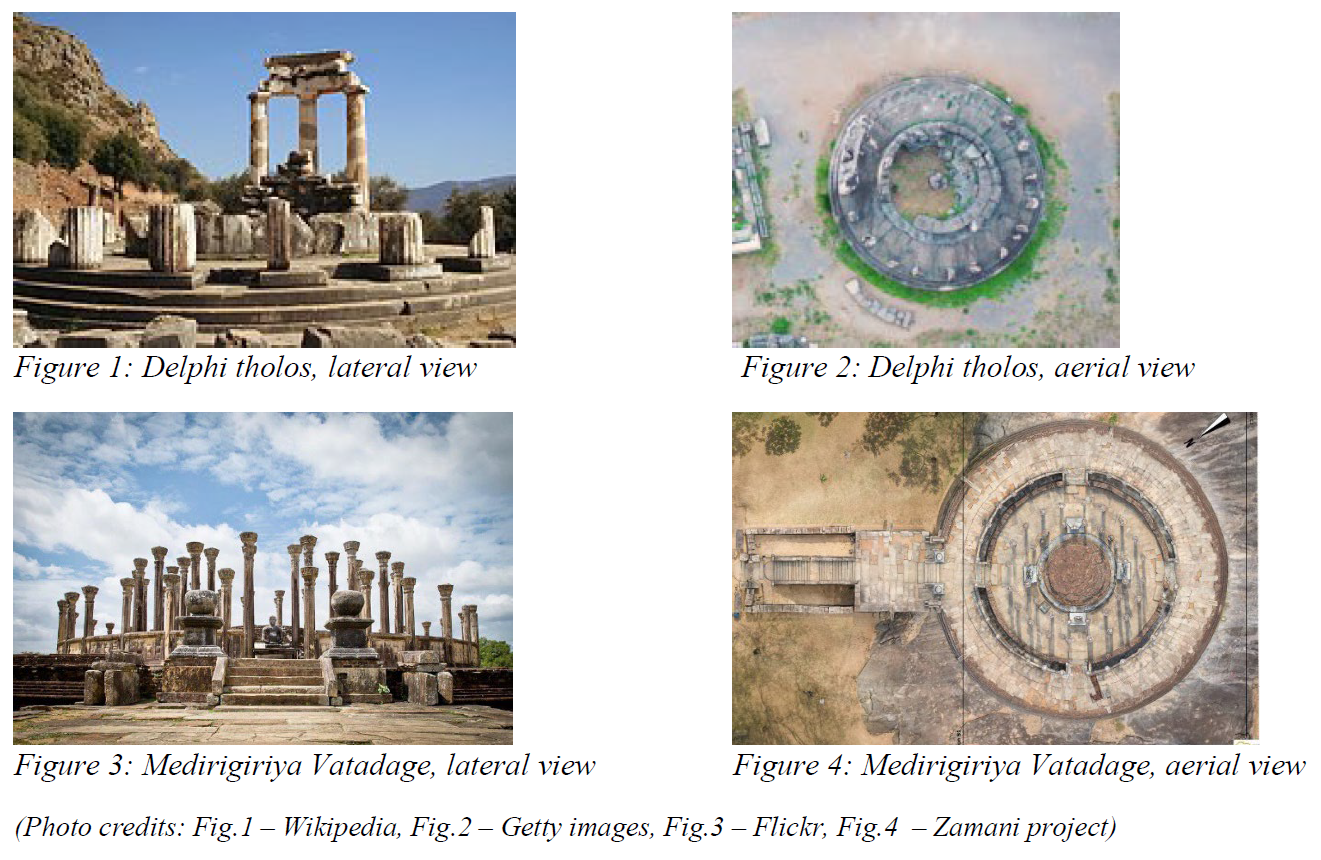
To begin with, the images below depict the lateral and aerial views of the Delphi tholos in Greece and the Medirigiriya Vatadage in Sri Lanka. The similarities and differences are further analyzed in later sections.
Overview
My study is focused on three significant characteristics between the Tholos and Vatadage. The first is the structural comparison and illustrating where they share certain architectural and engineering attributes, as well as where they differ. The second is to draw a hypothetical path of influence based on historical data. The final characteristic is to compare the symbolic function of these religious structures to understand the purposes why they were built.
2.1 Definitions (Tholos and Vatadage)
It would be helpful to define the primary terms used throughout the essay.
Tholos: The architecture of the shrine at Delphi is called a tholos which was built upon a round, stone platform with a circle of columns. It is a circular building with a conical or vaulted roof and a peristyle colonnade. (Figure 1)
Vatadage: The Vatadage is a colonnaded Buddhist shrine enclosing a small stupa. A stupa is a dome-shaped Buddhist structure. The word, “vata” means “circle” and “dage” means “relic-house/shrine” in Sinhala. The literal translation is, “circular-relic-house.” (Figure 3)
2.2 Potential paths of influence
While the Vatadage and the Tholos have some structural resemblance, that alone does not imply a shared history as the two countries are over 4000 miles apart. However, there are two possible modes worth consideration. One is the arrival of Buddhism in Sri Lanka in the third century BCE and plausible Greco-Indian architectural influence. The other, is the direct connection between the countries in ancient times (both with seafaring traditions), as supported by historical
records.
In later chapters, historical data will be presented to illustrate the ties between the two countries, including proof of Greeks living in Sri Lanka. In Sinhala (and Pali), they were known as ‘Yona’. The Sanskrit term is ‘Yavana’. These terms etymologically link to the Greeks as they both refer to “Ionians.”
This group of people have been repeatedly referenced in ancient literature, not just in Sri Lanka. The fact that Greeks were living in Sri Lanka is fundamental to the unique relationship between the two ancient civilizations. Additionally, it bolsters the hypothesis of the possibility of transmission of design and the concomitant influence on the ancient Sri Lankan architecture.
To investigate the theory of a path of influence, I have surveyed Greek influence outside of Sri Lanka as well. The assumption is that exploring the regions in between Greece and Sri Lanka may reveal evidence for potential path of influence. These regions would include parts of the Middle East, and the south Asian subcontinent.
2.3 Transmission of Design and Coulton’s Theory
The primary focus of this paper is to study the modes transmission of design applications. However, architectural influence cannot happen in a vacuum. That is to say, it was not a standalone event. It is also important to consider other ‘collaborative’ factors. One such driving force is the cultural influence in affecting a region’s architecture. To illustrate that point, Chapter 6 is devoted to the early history in the regions before the arrival of Greeks. This is contrasted with the situation in the regions after the Greek influence.
Coulton’s Theory
In researching the modes of transmission of ideas, it is helpful to review the theoretical foundation first. Coulton offers a description of what that entails. According to him, the transmission of architectural ideas is driven by several forces, primarily the masons and the architects.
- Craftsmen: Helps spread detailed traits, whether technical, such as specific forms of a mechanism such as a clamp, or stylistic – new types or arrangements of decoration.1
- Architects: Tend to be more concerned with matters such the relation of the one part of a column to a surrounding colonnade.2
- Patron: Could play a considerable part in assembling the ideas plus influence in such matters.3
- Workmen: Would spread new ideas by themselves moving from place to place.4
The present study is focused on the analysis of architectural, cultural, and symbolic characteristics. In this context, Coulton’s method offers an explanation on the role played by the above categories: Bactrian satraps such as Menander’s Patronage helped bring Hellenistic architectural traditions via Silk Road to north India. Similarly, the Architects and Craftsmen may have transmitted the knowhow via travel during the spread of Buddhism in the Indian subcontinent. Finally, maritime and overland trade during Greek and Roman times may have contributed to the movement of skilled Workmen.
 GIS Applications